
Global women’s driver survey reveals confidence and stress
Hey, women car buyers, need help finding your next vehicle? Then head to AutoMuse ProAdvice.
Women's Worldwide Car of the Year celebrates International Women Drivers' Day, on 24 June, and a global survey has shown how female drivers perceive their confidence or stress behind the wheel.
A survey led by the Czech online magazine for women drivers Zenavaute.cz asked 1,720 women drivers worldwide via online questionnaire.
The survey was carried out during May/June 2026 in 33 countries around the world, including New Zealand, where AutoMuse founder Liz Dobson is a judge for Women’s Worldwide Car of the Year.
The survey showed that women drivers rate their driving skills as safe and focus their full attention on driving. There were 97% of women who considered themselves “safe driver” while only 3% admit they “sometimes drive unsafely”.
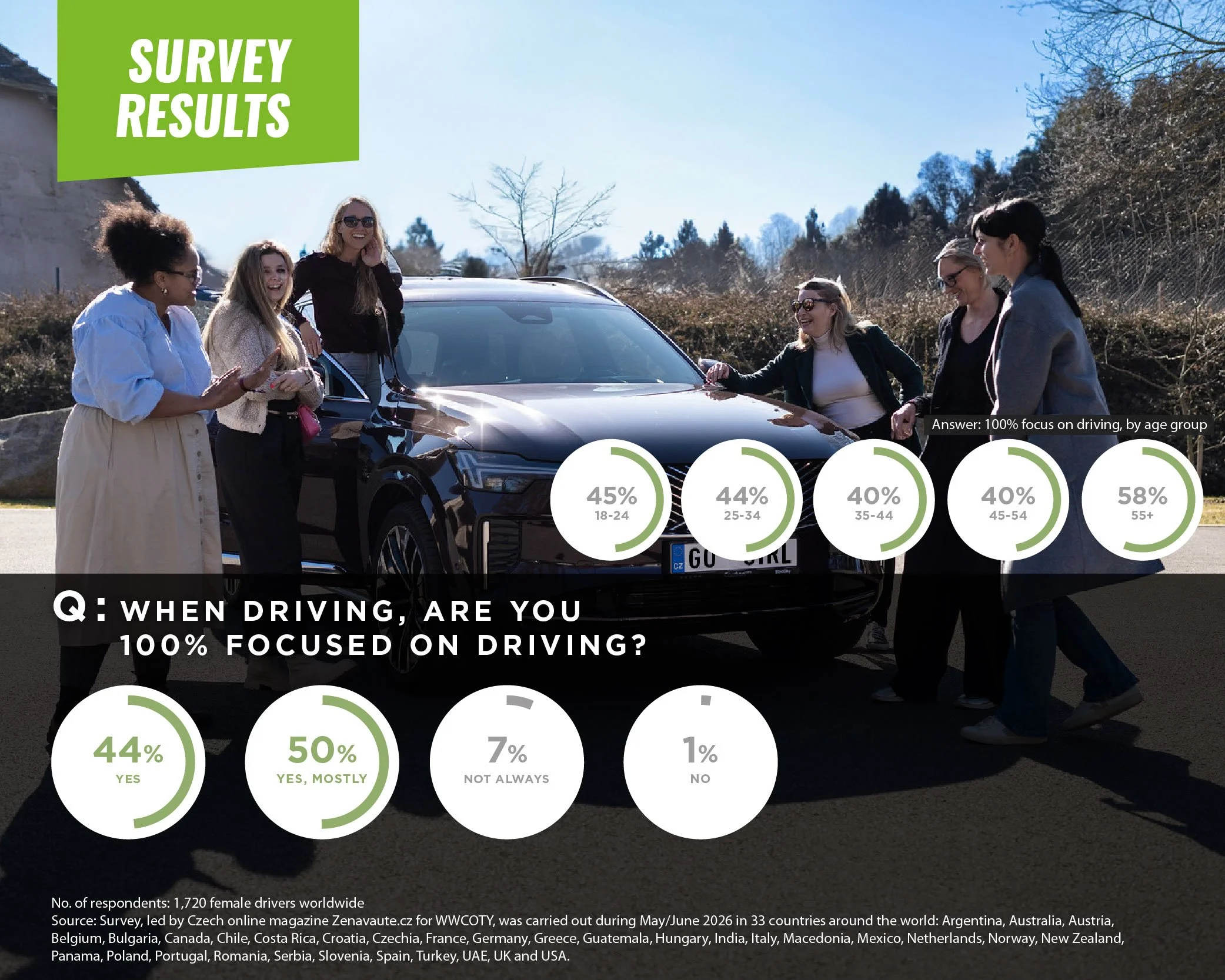
According to the survey, a total of 94% of women drive with full or mostly full concentration. Only 6% admit they “cannot always focus completely”.
Sabina Kvášová, the survey’s organiser and editor-in-chief of the magazine Žena v autě.cz, noted that regular practice built driving confidence. Daily drivers were 97% confident that they drove safely. Occasional drivers have a notably higher uncertainty rate (19%).
Who is the best focused driver according to the survey? Women over 55 report the highest rate of “full focus while driving” (58%). The 25-34 group has the highest partial distraction rate (8%). Drivers aged 35-54 predominantly respond “yes, mostly”.
The survey revealed a paradox. The less a woman drives, the higher her reported level of concentration. Interestingly, daily drivers report partial concentration more often (54% “mostly”). Occasional drivers more frequently report “full focus” (65%) — likely because they approach driving more consciously.
Women are said to be masters of multitasking. What are they able to do while driving? Nearly one in two women admitted to “using a cell phone (legally) while driving” (48%). Their perception of safety thus does not match their actual behaviour behind the wheel. When asked whether they drive safely, the majority answered “yes.”
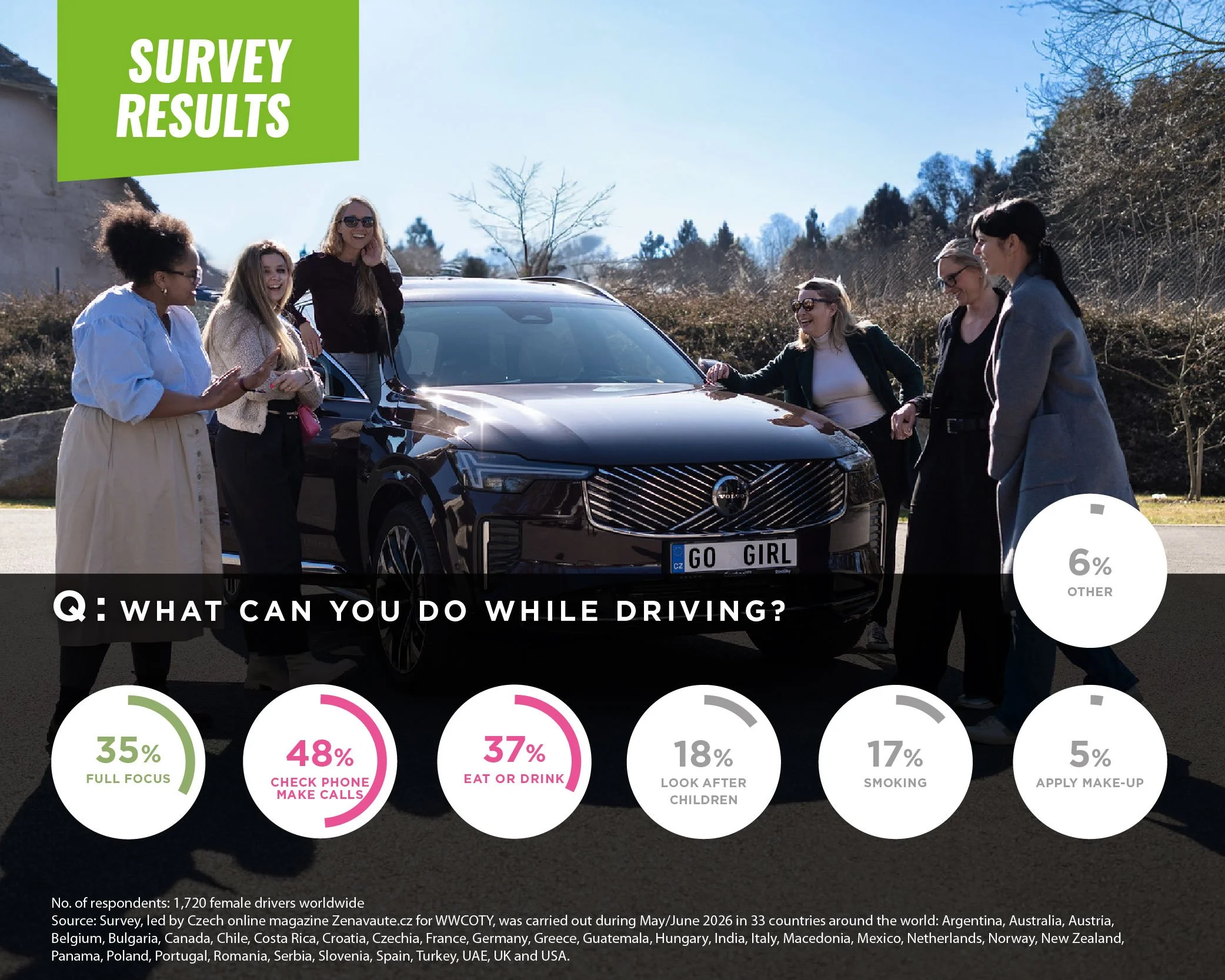
More than a third of respondents (37%) “eat or drink while driving”. Another third of the respondents (35%) report “being fully focused on driving”. The third most common distraction is “checking on children and providing snacks for them” (18%), followed by “smoking while driving” for less than a fifth of respondents (17%). Only a small proportion of women (5%) admitted that they sometimes “finish their makeup while driving”.
The survey showed that the most significant source of stress for women drivers is “the behaviour of other drivers” (70%). This applies to female drivers of all age groups.
It is interesting to note that women drivers were more likely to select multiple answers to this question. For nearly one in three women drivers, the following seven examples and situations are triggers for stress behind the wheel: “traffic” (51%), “bad weather/reduced visibility” (36%), “time pressure/rush” (36%), “searching for parking” (34%), “traffic and intersections” (28%), “uncertain route” (24%), or “a passenger who gives advice” (21%).
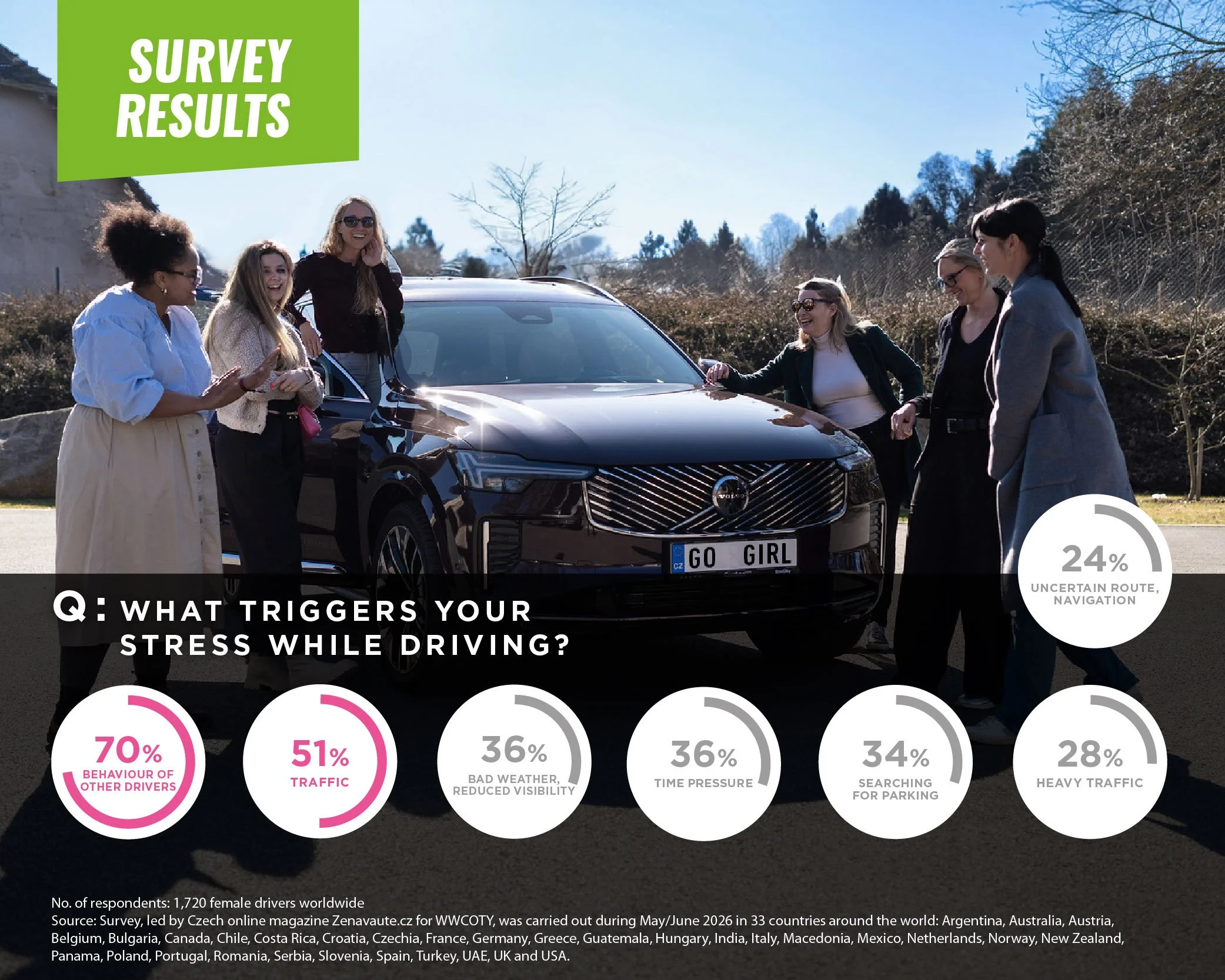
Other driver behaviour is the top stressor across all ages, peaking at 82% for drivers between ages 18-24. “Stress from a crying child” peaks in the 35-44 group (26%), corresponding to active parenthood. Older women worry less about “time pressure”.
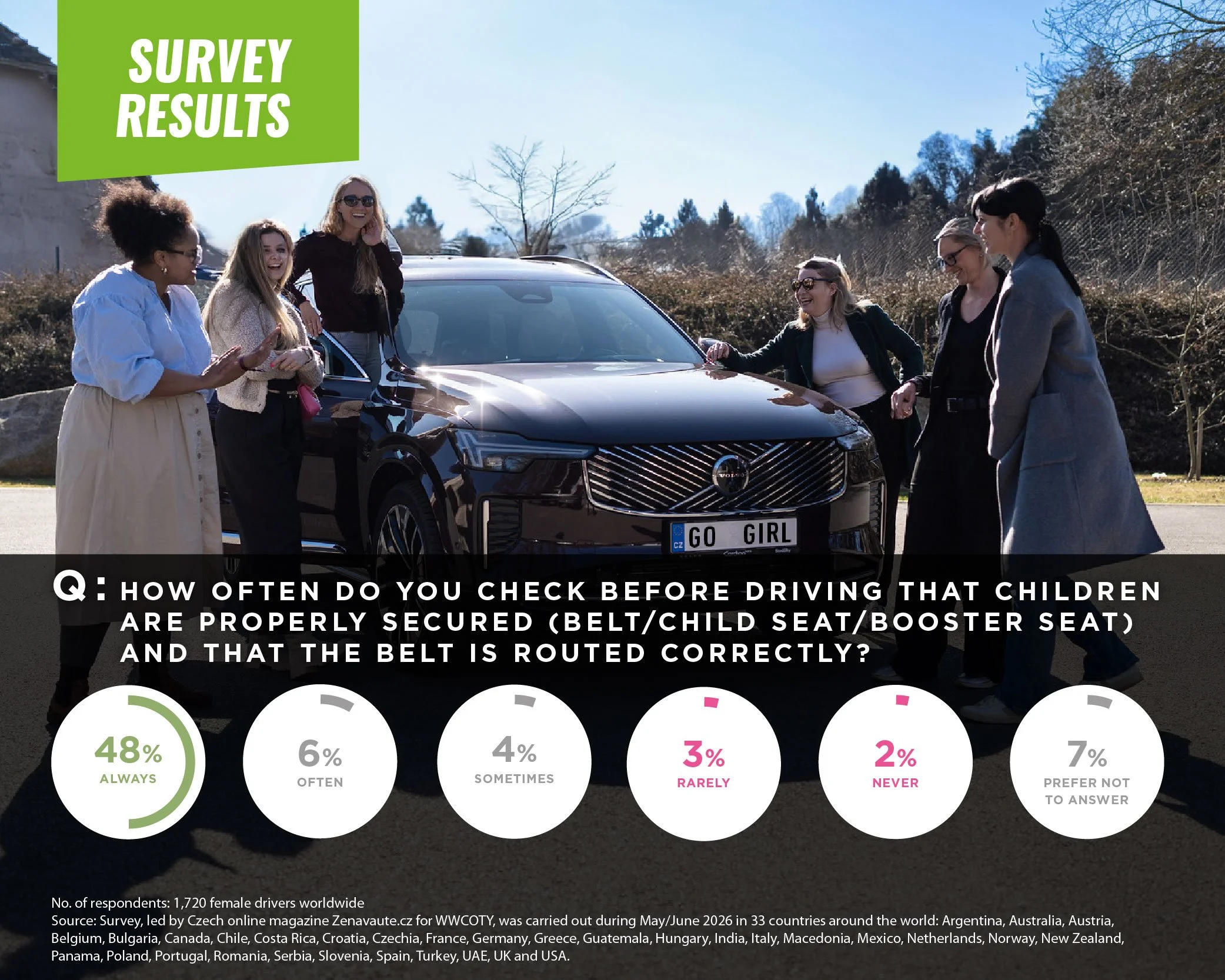
The vast majority of mothers (76%) “always” or “often” check children's seatbelts before setting off. On contrary, only 2% “never check”.
Most mothers find car seat installation manageable. Among women who install a child car seat (75%), 77% feel “comfortable” or “very comfortable” with installing and adjusting it. Only 13% report difficulties.
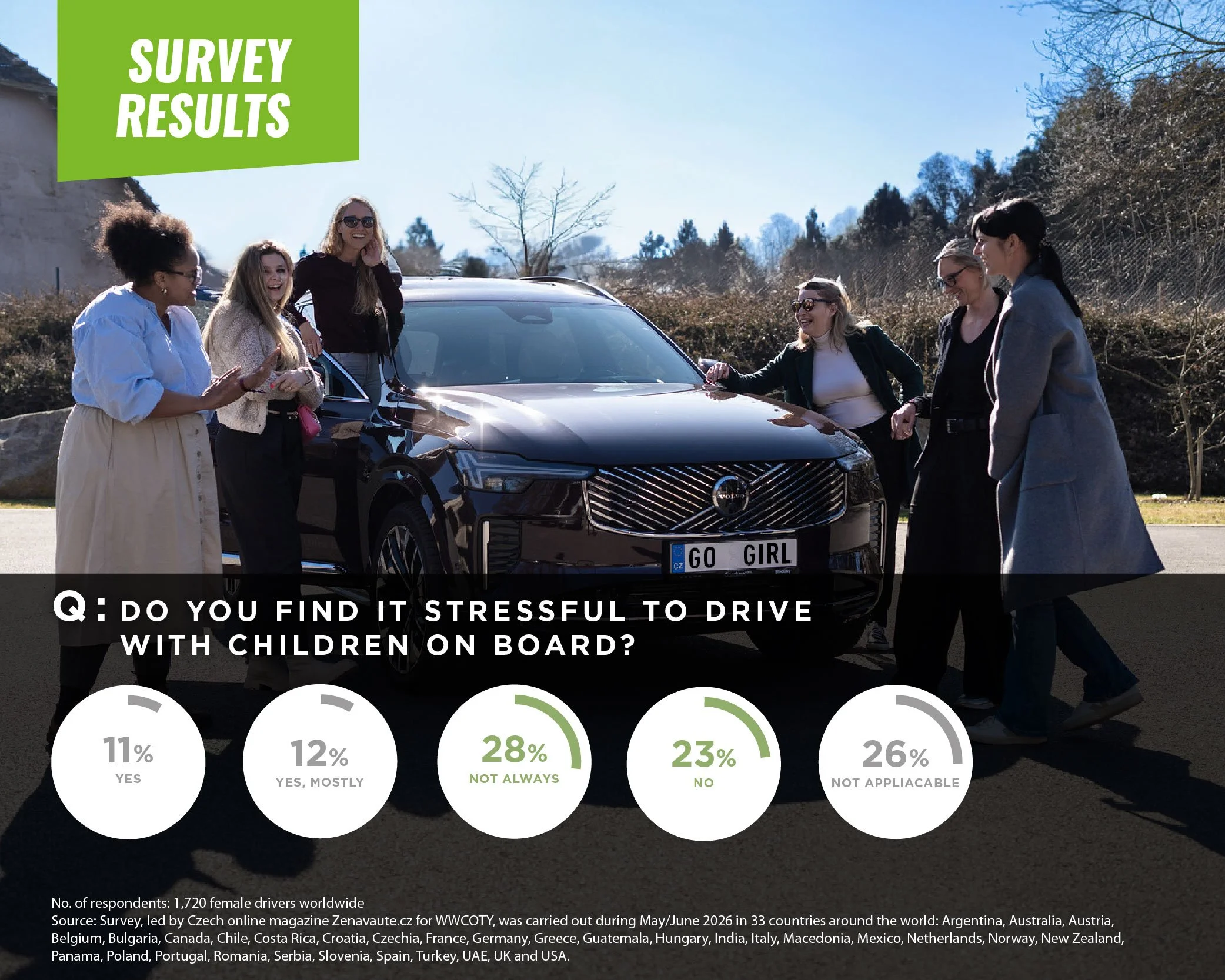
Nearly half of all female drivers, who are mothers, say that driving with their children in the car “is not stressful” for them (51%). However, 23% consider driving with their children “to be stressful”.
What is International Women Drivers' Day?
It vindicates mobility as an inalienable right that contributes to the freedom, dignity, and personal and professional development of women, and is the perfect moment to highlight this survey, according to WWCOTY president Marta Garcia.
“Driving opens the door to independence for millions of women around the world to seek a better future, to achieve fairer living conditions, and to pursue their passion for motorsports.
"International Women Drivers' Day also commemorates the day in 2019 that the ban on women driving in Saudi Arabia was lifted. On that day, women gained mobility and personal freedom
by discovering the joy of the automobile. They became more visible and made society aware of the potential of more than 50% of the population formerly not allowed to drive.”